
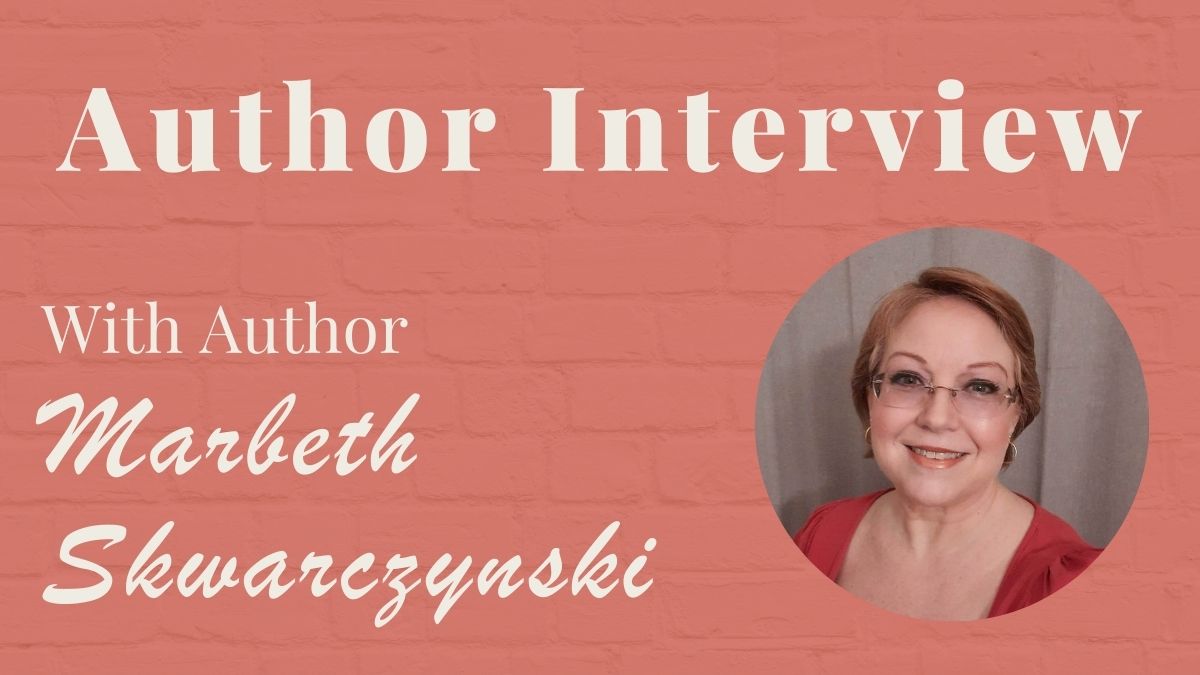
With my love for women in the Bible, I always get excited when I see a new book about a Bible woman. Marbeth Skwarcynski is a fellow Elk Lake Publishing author, and when I saw her posts about her new release Princess of Moab: A Novel of Ruth, I was intrigued.
I had no idea Ruth was a princess, but I immediately did some research and learned there was more to Ruth than I’d realized. I reached out to Marbeth to learn more about the book and what she’d learned writing it.
Author Interview

When did you first decide you wanted to be a writer?
I was a late-in-life writer, not starting my first novel until I was in my 30s. I’ve always been a storyteller, though. I taught Sunday school, Jr. church, Awana, and Bible classes at my church’s Christian school.
Describe your journey as a writer.
My storytelling in various church classrooms evolved into a long novel about the life of Ruth. Not long after the rough draft was completed, I began teaching history and literature at the Christian school. Initially, I put my writing on hold while I was busy creating lectures. As time went on, however, I began using my writing skills as a tool for my classroom. Many of the textbooks I used were missing vital information, and I would photocopy handouts to fill the gaps (the English literature textbook had NO women writers in it—no Austen, Bronte, or Shelley!). Eventually, I realized that the handouts and reading books I was providing had outpaced the curriculum. I compiled my various materials, added some homework assignments and commentary, and had them printed and bound for the classroom.
During school holidays, I began writing contemporary Christian novels in a series called The Rose Collection. By the time I left teaching, I had four novels ready for revision, editing, and preparation for publication. I’ve released seven books in the past five years and have two more in the late editing stages. My goal for The Rose Collection is twelve novels (a dozen roses).
Last year, one of my online friends—and fellow author—Jane Daly posted that she was looking for authors to join Elk Lake Publishing. I mentioned the first book I wrote (and re-re-re-wrote), and she suggested I submit it. They offered me a contract (YAY!) and walked me through the publishing process. Now, Princess of Moab: A Novel of Ruth is finally ready for readers.

Tell us about your upcoming release, Princess of Moab: A Novel of Ruth.
Princess of Moab: A Novel of Ruth follows the main character’s last ten years in Moab. It opens with her as a seventeen-year-old working princess in the city of Kir-Hareseth. Her mother, Thisbe, holds the highly ranked position of First Wife. While her mother is respected, she’s also a target for the political and religious leaders who are jealous of her influence. For the most part, Ruth has been separated from society and doesn’t quite understand the complexities of the Moabite political system. She is aware, however, that life in leadership can be dangerous and that her mother’s loving “protection” may have left her unprepared for what life has in store.
What was the inspiration for it?
The inspiration for Princess of Moab: A Novel of Ruth came from two unrelated sermons preached by different pastors. The first pastor was preaching on David’s anointing and made a throw-away statement about how he wondered if David’s family kept the sandal from Ruth’s story in a place of honor. It would have been a sweet reminder of their history. I loved that idea, and in my original draft, I began my book with a prologue where David’s grandfather, Obed, explains the significance of the shoe.
The second pastor was preaching on the book of Ruth, but as an aside, made a statement about Naomi giving her daughter-in-law the silent treatment. He wondered what it would be like for Ruth, a newly widowed woman, to travel in a caravan with someone who refused to speak to her. As a novelist, I found the pain and mourning of both women to be worth exploring. While I hint at it in my current novel, I hope to fully develop that part of the story in a future work.
What was your research process?
One of the many benefits of writing a historical novel while attending college classes is the wealth of information available. Many of the little touches of the Moabite culture came from early literature and art history lectures and textbooks. Fortunately, the cultures in the Fertile Crescent and the Mediterranean were very cosmopolitan. Trade, art, music, and the oral literature tradition were openly shared and received.
Women of high rank were often married off to powerful men as a way to solidify friendships between kingdoms. I present this practice in the novel through the four wives of the king. Thisbe (first wife and Ruth’s mother) is half-Ethiopian and half-Babylonian. Sheeva is Indian. Cera is Greek. Judith is an Edomite. Each wife brings her culture’s practices, fashion, and insights. All are tasked with making Moab a stronger nation through specialized work, including animal husbandry, protocol, agriculture, and horticulture.
What was the most interesting thing you learned during your research?
One of the things that struck me during my research was how well-traveled people were thousands of years ago. For the most part, cultures welcomed those from other nations, eager to trade and exchange information.

What else have you written?
So far, I’ve published the first seven books of a twelve-book series, The Rose Collection. Each novel spotlights healing after spiritual abuse. I keep my books realistic, timely, and conversational. I want my readers to feel like they are sitting down with a friend.
I wrote my one non-fiction book, The Women Who Set the Precedents, the year after I left teaching. My sister insisted. I had reframed Proverbs 31 as a Women’s Bill of Rights for my American history classes. Our textbooks dedicated a single page to the Seneca Falls Convention and the Declaration of Sentiments and Resolutions. I wanted to dig deeper into what the Bible says about women, so I went to the chapter that is consistently applied to women: Proverbs 31. Taking the last ten verses, I focused on the “this is what a virtuous woman IS” rather than the more popular teaching of “this is what you must DO to be a virtuous woman.” That handout for my classroom (here is the verse, and this is the godly right it guarantees) became the basis for the book.

Tell us about The Women Who Set the Precedents.
I began with the writer of Proverbs 31, who is traditionally identified as Bathsheba. I studied her whole story from the horrific rape at the hands of the most powerful man in Israel (with the full knowledge of HIS advisors), to her exoneration by the prophet Nathan, to losing her first child and giving birth to four more sons, and finally, standing up for her son, Solomon, to ensure his right to the throne. Knowing her story shines a different light on the first ten verses of Proverbs 31. She speaks with sorrow, experience, and wisdom in her attempt to keep her youngest son from following in his father’s faltering footsteps.
When it came to the second ten verses of the chapter, I assigned one biblical woman to each “right”:
- Bathsheba: right to be wise
- Rahab: right to be virtuous
- Abigail: right to be trustworthy
- Love (from Song of Songs): right to be profitable
- Rebekah: right to be strong
- Tabitha: right to be talented and compassionate
- Esther: right to be fashionable
- Huldah: right to be reputable
- Lydia: right to be happy in a career
- Deborah: right to be wise and kind
- Ruth: right to be energetic and respected
- Mary and Martha: right to be excellent and godly
- Mary: right to develop her own reputation
What else are you working on?
My focus for 2026 is the relaunch of The Rose Collection. I’ve learned a great deal over the past five years of writing/publishing. I’m tightening some of the story lines and fixing the timeline, formatting, and grammatical errors that slipped through the first time.
Along with the updated stories, I’m working with my graphic artist to create some beautiful new illustrated covers. Starting in January, I’ll be relaunching The Rose Collection throughout the year. In September, a brand-new Rose Collection book titled At-Home Daughter will be made available, and in November, the Christmas book, 31 Days of December, will be released.
Anything else?
I’ve got a head full of stories, so I don’t think I’ll slow down anytime soon. I would love to continue the story of Ruth, following her journey and life in Bethlehem. Maybe I’ll finally be able to add the detail of the sandal as a marker of the family’s history.
Learn More
Marbeth Skwarczynski on Facebook
Marbeth Skwarczynski on Instagram





Let’s chat! What are your thoughts?