
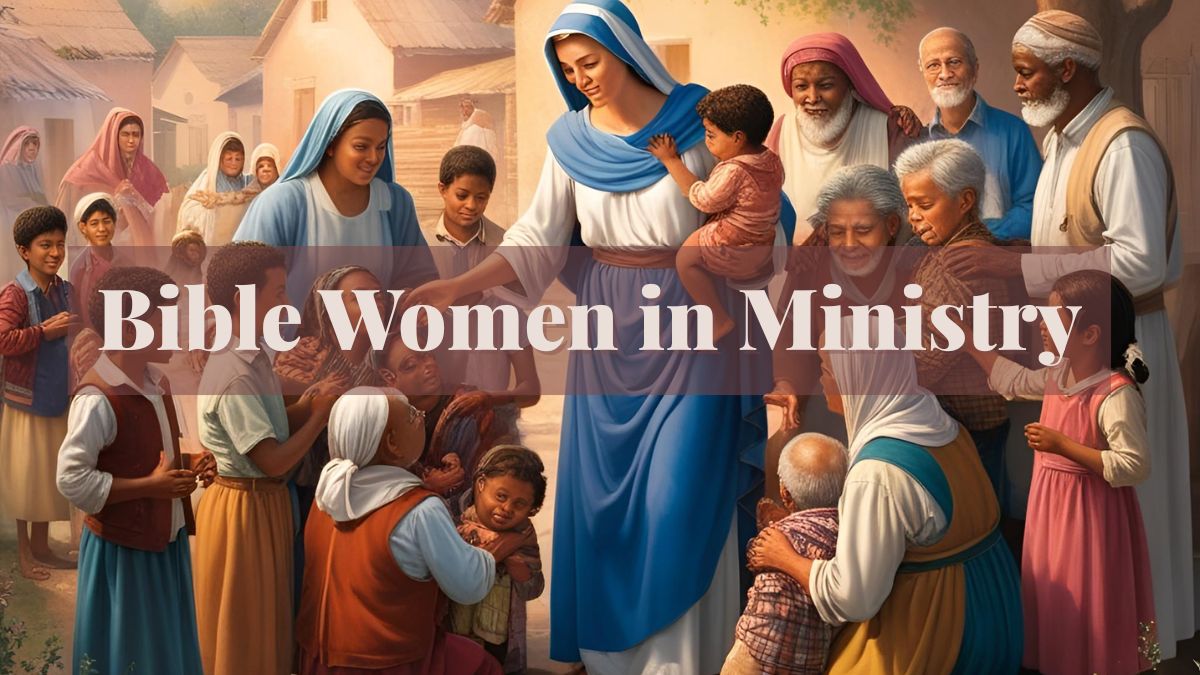
As Southern Baptists prepare to gather for the annual SBC Convention, the role of women in ministry is hot on everyone’s mind. As I’ve listened to the back and forth discussions of both sides, I felt a need to turn to the Bible and study the subject in context.
Though I’ve done my share of women in the Bible studies, looking at them specifically from the perspective of women in ministry, I found it quite eye-opening. The Bible is full of stories of women who served in various capicities of ministry. Some women served in the shadows. Others were front and center.
We have Old Testament prophetesses, New Testament evangelists, and women who worked together with men behind the scenes as ministry partners. Each of these women were chosen by God and supported in their roles by the men in their lives.
Let’s take a look at ten different stories of women in the Bible who served in ministry capacities and see how they apply to women’s roles today.
Bible Women in Ministry
Miriam: Prophetess

Who Was Miriam?
In Exodus 15:20, we’re told that Miriam was a prophetess.
What Did Miriam Do?
After the Israelites left Egypt then escaped across the Red Sea, they rejoiced and worshipped the Lord. Moses led the congregation in a song of praise. Then Miriam led the women in their own praise and worship.
Then Miriam the prophetess, the sister of Aaron, took the timbrel in her hand; and all the women went out after her with timbrels and with dances.
Exodus 15:20
Later on, after the Israelites had been in the wilderness for awhile, Miriam led dissension against her brother Moses. She didn’t approve of his Ethiopian wife and rallied Aaron to join her in speaking out against Moses. She tried to say they were just as important as Moses, only God didn’t see it that way.
So they said, “Has the LORD indeed spoken only through Moses? Has He not spoken through us also?” And the LORD heard it.
Numbers 12:2
God made it clear that while He might speak to others like Miriam and Aaron, He had a special relationship with Moses. To make His point to Miriam, God struck her with leprosy, but when Moses pleaded her case, He healed her. Still, she had to spend a week in isolation before she was cleansed and able to rejoin the camp.
What Was Miriam’s Role in Ministry?
Miriam served in a role comparable to today’s worship leader or women’s ministry leader.

Daughters of Zelophehad: Petitioners

Who Were the Daughters of Zelophehad?
The Daughters of Zelophehad were five sisters named Mahlah, Noah, Hoglah, Milcah, and Tirzah. Their father died in the wilderness, and they had no brothers or other men in their family.
What Did the Daughters of Zelophehad Do?
They saw a problem and went to Moses to resolve the issue. They were concerned about the process of dividing the land grants in the Promised Land.
In Numbers 27:2, the sisters went went to the doorway of the tabernacle of meeting and addressed Moses, Eleazar the priest, the Israelite leaders and all the congregation.
Our father died in the wilderness; but he was not in the company of those who gathered together against the Lord, in company with Korah, but he died in his own sin; and he had no sons. Why should the name of our father be removed from among his family because he had no son? Give us a possession among our father’s brothers.”
Numbers 27:3-4
The young women pointed out that it wasn’t fair that single women without fathers or brothers would be left out of the land distribution process. So they asked Moses for help.
Moses took their concerns to the Lord, and He said the sisters were right, that they should receive an inheritance among their father’s brothers.
Later, when some of the men complained that women might receive undo inheritance if they married outside their tribe, Moses again took the situation to the Lord again, and based on God’s wisdom, directed that if the women wanted to retain their inheritance, they’d need to marry within their tribe. The daughters were fine with this, and each married among their father’s family.
When it came time for the Israelites to take over the Promised Land, the sisters went to Eleazar the priest, Joshua the new leader, and the rulers to remind them of Moses’s declaration.
The Daughters of Zelophehad saw a problem that not only affected them, but women for generations to come. To resolve their issue, they took it to God’s chosen leader., and God’s leader took it to God.
What Was Zelophehad’s Daughters’ Role in Ministry?
The Daughters of Zelophehad’s actions would be comparable to speaking out at a church business meeting or at a denominational convention. Moses listened to their concerns and took them to God who confirmed that the five sisters were right, and Moses should heed their request.
Huldah: Prophetess

Who Was Huldah in the Bible?
According to 2 Kings 22:14 Huldah was a prophetess, the wife of Shallum the son of Tikvah, the son of Harhas, keeper of the wardrobe. She dwelt in Jerusalem in the Second Quarter. The Second Quarter is translated as “the college”.
What Did Huldah Do?
The young King Josiah decided to clean out the neglected temple and repair it. In the process, Hilkiah, the high priest, uncovered the missing Book of the Law, an ancient scroll from the time of Moses. Hilkiah gave the book to Shaphan, the scribe, and Shaphan shared it with King Josiah.
The king then commanded the priests and servants to inquire of the Lord for him and gather an understanding of all that the book was talking about.
So, what did these religious leaders do?
So Hilkiah the priest, Ahikam, Achbor, Shaphan, and Asaiah went to Huldah the prophetess, the wife of Shallum the son of Tikvah, the son of Harhas, keeper of the wardrobe. (She dwelt in Jerusalem in the Second Quarter.) And they spoke with her.
2 Kings 22:14
They went to Huldah, the prophetess, to intercede to the Lord on their behalf.
Yes, you read that right. The priests went to Huldah, a woman. Why didn’t they go to God themselves? Why didn’t they consult the prophets Jeremiah or Zepheniah? Some Bible scholars speculate that the male prophets weren’t in Jerusalem at the time, and Huldah was. Still, it doesn’t change the fact that they went to a woman to hear a word from the Lord.
The words Huldah shared couldn’t have been pleasant to report.
Then she said to them, “Thus says the Lord God of Israel, ‘Tell the man who sent you to Me, “Thus says the Lord: ‘Behold, I will bring calamity on this place and on its inhabitants—all the words of the book which the king of Judah has read— because they have forsaken Me and burned incense to other gods, that they might provoke Me to anger with all the works of their hands. Therefore My wrath shall be aroused against this place and shall not be quenched.’ ” ’ But as for the king of Judah, who sent you to inquire of the Lord, in this manner you shall speak to him, ‘Thus says the Lord God of Israel: “Concerning the words which you have heard— because your heart was tender, and you humbled yourself before the Lord when you heard what I spoke against this place and against its inhabitants, that they would become a desolation and a curse, and you tore your clothes and wept before Me, I also have heard you,” says the Lord. “Surely, therefore, I will [c]gather you to your fathers, and you shall [d]be gathered to your grave in peace; and your eyes shall not see all the calamity which I will bring on this place.” ’ ”
2 Kings 22:15-20
What Was Huldah’s Role in Ministry?
Huldah was a prophetess. Since she lived in the college area of town, she could have been a college professor. She was a woman of God who was respected by men of God and treated as a spiritual authority.
Deborah: Prophetess and Judge

Who Was Deborah in the Bible?
Deborah was an Old Testament prophetess and judge in Israel and the wife of Lapidoth.
Now Deborah, a prophetess, the wife of Lapidoth, was judging Israel at that time. And she would sit under the palm tree of Deborah between Ramah and Bethel in the mountains of Ephraim. And the children of Israel came up to her for judgment.
Judges 4:4-5
What Did Deborah Do?
As the Israelite judge, Deborah was the one who gave wisdom and advice to anyone who came seeking.
In addition to advising those who came to her, Deborah called for Barak, who wasn’t seeking her out.
She said to him, “Has not the Lord God of Israel commanded, ‘Go and deploy troops at Mount Tabor; take with you ten thousand men of the sons of Naphtali and of the sons of Zebulun; and against you I will deploy Sisera, the commander of Jabin’s army, with his chariots and his multitude at the River Kishon; and I will deliver him into your hand’?” Judges 4:6-7
She wasn’t giving him a new command. She was only confirming what he’d already been told. But he was scared. He responded by saying the only way he’d go was if Deborah went with him.
So she went the seventy miles to the battle site and gave the orders to launch the battle. And when the Israelites won the battle, Deborah and Barak sang what the Bible calls “The Song of Deborah”.
What Was Deborah’s Role in Ministry?
According to BibleHub, the Old Testament judges were deliverers, military leaders, spiritual and moral leaders, and judicial authority. “The judges served as leaders raised by God to deliver the Israelites from the oppression of surrounding nations and to guide them back to covenant faithfulness.”
Deborah was a prophetess and a spiritual leader, chosen by God, to lead the Israelites, offering wisdom and advice to men and women alike.
Mary Magdalene, Joanna, and Susanna: Financial Supporters

Who Were Mary Magdalene, Joanna, and Susanna?
Luke 8 calls them “certain women who had been healed of evil spirits and informities. It goes on to say they were part of a group of women who provided financially for Jesus and His followers.,
What Did They Do?
Mary Magdalene, Joanna, and Susanna, as well as Mary, the mother of James followed Jesus and used their financial resources to provide for the needs of Jesus and His followers. They listened to His teachings. They took what He said to heart.
In Mark 15: 40-41, we’re told they were at the crucifiction, watching from a distance. Then we’re reminded again that they had traveled through Galilee, following Jesua and taking care of Him.
After Jesus’s death, Mark tells us in chapter 16 that these same women brought spices so they could annoint His body. They were the first to see the empty tomb. They heard from the angel, explaining that Jesus had risen from the dead and to go and tell the disciples.
Verse 8 says the women were scared and didn’t say anything. Some of the earliest manuscripts end there, but other manuscripts continued the story. Verses 9-11 says that Jesus appeared to Mary Magdalene, and she then told the disciples who were “mourning and weeping.” When she told them that Jesus was alive, they didn’t believe her. It wasn’t until they saw for themselves that they truly believed.
Now when He rose early on the first day of the week, He appeared first to Mary Magdalene, out of whom He had cast seven demons. She went and told those who had been with Him, as they mourned and wept. And when they heard that He was alive and had been seen by her, they did not believe.
Mark 16:9-11
What Was Their Role in Ministry?
These women played a vital role in providing financial support. Without their support, Jesus and His disciples would have been more limited in what they could do. Of course, Jesus doesn’t need our money. But their generous giving was used by God to further Jesus’s ministry.
Samaritan Woman at the Well: Evangelist

Who Was the Samaritan Woman at the Well?
In the beginning of John 4, the Samaritan woman is merely mentioned as a “woman of Samaria.” It’s not until Jesus engages her in conversation that we find out she was a woman who has had five husbands and was living with a man who wasn’t her husband.
Based on this description and the fact that she was drawing water during the heat of the day, we can gather she was an outcast in her community. She was not someone the proper women would have associated with.
What Did the Samaritan Woman Do?
The Samaritan woman was going about her everyday business when Jesus came to her. Though she didn’t understand what He was talking about in the beginning, she engaged in an interesting theological discussion with Him.
She knew about the prophets of old. She knew how the Jews worshiped. When she learned that Jesus was the promised Messiah, she immediately left what she was doing and ran to tell the others in her village.
The woman then left her waterpot, went her way into the city, and said to the men, “Come, see a Man who told me all things that I ever did. Could this be the Christ?” Then they went out of the city and came to Him.
John 4:28-30
What Was the Samaritan Woman’s Role in Ministry?
The Samaritan woman seems an unlikely candidate for ministry, yet Jesus used her as an evangelist to reach her Samaritan town. He knew about her past as well as her current situation of living in sin, yet Jesus chose this particular woman to launch revival among the Samaritans.
The definition of evangelist is one who shares the gospel. We are all called to share the gospel with those around us. The Samaritan woman is one who demonstrates how one woman whose life was changed by Jesus went on to share the good news with others.
And many of the Samaritans of that city believed in Him because of the word of the woman who testified, “He told me all that I ever did.”
John 4:39
Lydia: Woman of Prayer, Evangelist, Church Planter

Who Was Lydia?
Acts 16:14 tells us Lydia was a God-fearing woman and a dealer in purple cloth. She was from the city of Thyatira, but was in the city of Phillipi. From this brief description we can tell that she was a woman seeking after God She was a business woman–a working woman with her own business. And she was a wealthy woman. She was from Thyatira but had a home in Philippi.
Now a certain woman named Lydia heard us. She was a seller of purple from the city of Thyatira, who worshiped God. The Lord opened her heart to heed the things spoken by Paul.
Acts 16:14
What did Lydia Do?
Though Lydia was a busy, working woman, she made time to worship God. Since there was not a synagogue in their city, she and a group of women went each Sabbath day to the river to pray.
It appears that these women were familiar with the Old Testament teachings, but didn’t know about Jesus and His plan of salvation. When Paul came and shared with her and the other women, the Lord opened her heart to respond and she was baptized.
She must have shared with her household servants because verse 15 tells us that not only was she baptized, but so was her household. She then went on to invite Paul and his traveling companions to stay at her house while they were in the area.
And when she and her household were baptized, she begged us, saying, “If you have judged me to be faithful to the Lord, come to my house and stay.” So she persuaded us.
Acts 16:15
Lydia’s home in Philippi became a gathering place for believers. After Paul and Silas were arrested and unlawfully imprisoned, they returned to Lydia’s house where they found brothers and sisters in Christ gathered together and encouraging them.
What Was Lydia’s Role in Ministry?
Lydia was a woman of prayer and an evangelist who went on to become a church planter. She opened her home to the men and women of God, providing them a place to gather together.
Priscilla: Teacher, Church Planter

Who Was Priscilla?
Priscilla is one of the more prominent women in the New Testament. When we first meet Priscilla in Acts 18, we learn that she’s a Jew, the wife of Aquila. She was from Italy, but they’d been forced to immigrate to Corinth because of their Christian beliefs. She and Aquila were tentmakers.
Unlike most instances in the Bible where the husband’s name is mentioned first, Priscilla’s name often comes first. This signifies a certain prominence, which is especially interesting when her name comes first when talking about their ministry work. It would appear that Priscilla may have been more outgoing or prominent, though the two always worked together, whether making tents or sharing the gospel.
What Did Priscilla Do?
The first thing Priscilla and Aquila did was welcome Paul into their home, letting him stay with them and be a part of their tentmaking business.
When Paul decided it was time to leave Corinth and go to Syria, Priscilla and Aquila went with him. He left them in Ephasus when he continued on to Jerusalem.
While they were in Ephasus, Priscilla and Aquila met an eloquent speaker who was preaching about God, but didn’t have a full understanding of Jesus and His mission on earth. So Priscilla and Aquila took him aside and educated him on the gospel message.
Now a certain Jew named Apollos, born at Alexandria, an eloquent man and mighty in the Scriptures, came to Ephesus. This man had been instructed in the way of the Lord; and being fervent in spirit, he spoke and taught accurately the things of the Lord, though he knew only the baptism of John. So he began to speak boldly in the synagogue. When Aquila and Priscilla heard him, they took him aside and explained to him the way of God more accurately
Acts 18:24-26
In Romans 16:3-4, we learn that at some point, Priscilla and Aquila risked their lives for Paul. He doesn’t provide further details, but we see his gratefulness to them.
Greet Priscilla and Aquila, my fellow workers in Christ Jesus, who risked their own necks for my life, to whom not only I give thanks, but also all the churches of the Gentiles.
Romans 16:3-4
In 1 Corinthians 16:19, we’re told that Priscilla and Aquila had a church that met in their home
What Was Priscilla’s Role in Ministry?
Priscilla is the perfect example of a helpmeet. She served alongside her husband in his business. She opened up her home to host Paul. When she and Aquila saw a situation that needed to be handled, they handled it together. They traveled numerous times, and each place they lived, they opened their homes to become home churches.
Daughters of Philip: Prophetesses

Who Were the Daughters of Philip?
Not much is told about the daughters of Philip other than they were four virgin sisters whose father was Philip the evangelist.
On the next day we]who were Paul’s companions departed and came to Caesarea, and entered the house of Philip the evangelist, who was one of the seven, and stayed with him.
Acts 21:8
What Did the Daughters of Philip Do?
Acts 21:9 says the girls prophesied. Also, when Paul and his ministry team were in Caesarea, they stayed with Philip and his daughters. Since no wife or mother is mentioned, we can assume the daughters took care of the missionaries, feeding them and providing hospitality for them.
What Was the Daughters of Philip’s Role in Ministry?
As prophetesses, they were likely teachers or speakers of some kind. In addition, it appears they assisted their dad with his ministry.
Phoebe: Church Ministry Leader

Who Was Phoebe?
Based on her name, she was a Greek. Her name also has idoltrous connotations as a worshiper of Apollo. But according to Romans 16:1, Phoebe was a servant of the church in Cenchrea. The city she lived in was known for its wickedness. So to be a Christian from there was no small deal.
What Did Phoebe Do?
Phoebe worked in the Cenchrea church helping Paul and others within the church. What exactly did she do? We don’t know. The Greek word used for servant here is the same word used for deaconess. According to Strong’s Greek 1249 the word means “an attendant, i.e. a waiter; specially, a Christian teacher and pastor.”
Whatever it was, it was a leadership position because Paul was telling the church of Rome to do whatever Phoebe needed them to do. She was in charge of something and calling the shots. And Paul appreciated her leadership.
I commend to you Phoebe our sister, who is a servant of the church in Cenchrea, 2 that you may receive her in the Lord in a manner worthy of the saints, and assist her in whatever business she has need of you; for indeed she has been a helper of many and of myself also.
Romans 16:1-2
What Was the Role of Phoebe in Ministry?
Phoebe was a church worker and leader., responsible for taking care of others. She was someone Paul sanctioned to get ministry done.

I trust you’ve found this study of Bible women in ministry useful. I know I’ve enjoyed digging deep and looking at the many ways God allowed Bible women to serve and help spread the gospel.
I challenge you to do your own study. Don’t just go by what other people tell you. Search the Bible yourself. Use a study Bible, commentaries, or online resources like Bible Gateway and Bible Hub to help you out.
Determine for youself what the Bible says about women in ministry by looking at the examples provided for us in the Bible. Study these women and the work they did. Then strive to find ways that God can use you to serve right where you are to help further His kingdom .
I’d love to hear how God is calling you and using you to serve in your own personal ministry.
Pin For Later






Let's chat! What are your thoughts?